
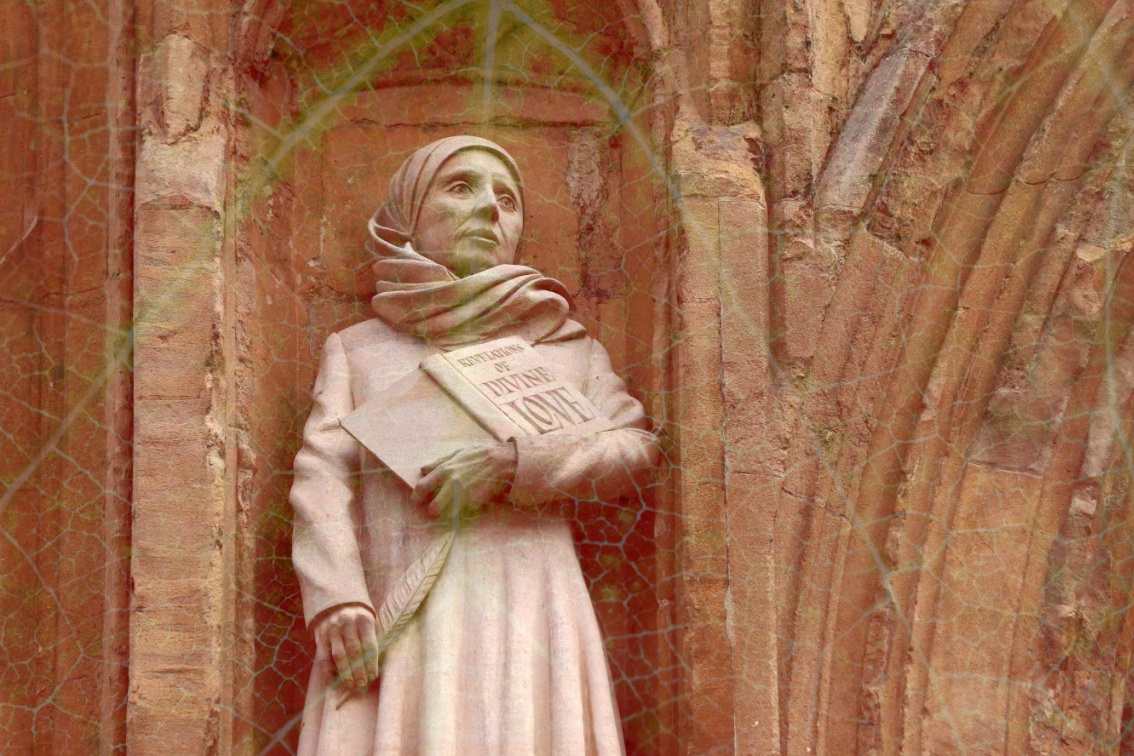
Note: This post is the fifth in a series. To read it in context, start here.
Spiritual lineage is not passed down through genetics, but through a shared fire, a common vision, and an awakening that passes from heart to heart.
—Richard Rohr
In the sight of God, all humans are oned, and one person is all people, and all people are in one person.
—Julian of Norwich
She is widely considered the first known woman to write a book in the English language, a contemporary of Geoffrey Chaucer, though her writings would not become widely known until six centuries after her death.
We know very little about her early life in the port city of Norwich, England. But we do know that whatever security she felt in the world must have utterly shattered when she was just six years old.
In the year 1349, the Black Death first swept through the region, killing more than half of her neighbors, friends, and loved ones in mere months.
For the rest of her life, she contended with bitter memories of the nauseating stench that penetrated the air she breathed, inescapable; the cartloads of bloated, decaying bodies wheeled by her house; and then the piles of bodies left rotting in the streets when the cart-drivers couldn’t keep up, when even the diggers of mass graves succumbed. Of course, she often recalled with great sorrow the day that one of those carts stopped outside the door of her own house. How could she forget?
When the plague finally receded, she heard the church bells ring as before, but they sounded less like the joyous call to prayer that she had known and more like a ceaseless death knell. Her mother took her to the market again, but the bustling crowds had thinned and grown somber, their faces still marked by terror, helplessness, and grief.
The religious processions that wove through the streets also left a deep impression on her young mind. No more the celebratory pageantry that gave her such delight. Now, men stripped to their waists violently whipped their own bodies while they confessed their sins and sang penitential hymns. Their message was clear: the Black Death had been sent by God as punishment for sin, an expression of God’s righteous anger. Therefore, we need to repent by inflicting punitive violence upon ourselves, to plead for mercy lest God’s wrath descend upon us again.
“Is this why so many people had to suffer and die? Is this what God asks of us?” she wondered. “Who is God, then? And who are we in God’s eyes?”
These and other questions haunted her with nagging insistence, generating a fervent desire to know God in her own experience—to know that God is a God of love and not violence; that God does not inflict suffering but suffers with suffering bodies, as Jesus suffered and died on the cross as one of us, his twisted and mangled corpse a mirror of the horrors she witnessed. She yearned to be transformed in her whole being in order to know and love God more deeply. In her youthful zeal, she even desired an illness that would bring her close to death, in solidarity with so many she knew who had thus passed on, believing that this would purify her spirit. She needed to know that we are not alone after all, helpless and abandoned to such utter catastrophe.
For the next eleven years, Norwich was spared. But then another wave of the Black Death swept through, this time less severe overall yet disproportionately striking down children.
“Would a loving God take his wrath out on mere children?”
And then another wave of the Black Death eight years after that.
In May of 1373, when she was thirty years old, she too contracted an illness that took her to the threshold of death, as she had once desired. She lay bedridden for four days, attended by her mother, ready to consent to death without fear. In her heart, she felt that she had nothing left to live for but God. And if it was God’s will that she should die, then so be it.
And so death came for her. She felt the life-force leave her body, beginning at her feet, moving up through her legs, to her waist. Clearly, she knew, this was the end.
Just then, a cleric entered the room. He stepped to her bedside, held up a crucifix and said, “Look upon your maker and take comfort.” And with some effort, she did.
Immediately, her sight began to fail and the whole room went dark as night. Yet the crucifix remained visible to her, as if mysteriously suffused by its own illumination. She felt death start to take the upper half of her body now. She could hardly breathe.
And then…
In a flash, she knew not how, but all pain and discomfort completely left her. In fact, she felt more at ease in her body than she had ever known. Her gaze still rested on the crucifix before her. That’s when she noticed that the head of Christ, wrapped in a crown of thorns, was suddenly shedding copious amounts of blood.
Thus she remained for several hours, peering through death’s door while still alive in body, absorbed in a series of visions. She saw things as if by physical sight, heard words that formed spontaneously in her mind, and received unmediated insight into truths beyond ordinary perception or comprehension that could never be adequately conveyed in words. She received her heart’s desire—direct knowledge of God’s suffering with us, for us, for love alone. And she saw without a shadow of a doubt that there is no wrath in God, that all wrath is on our side (“How could we be so blind to ever think otherwise?”), which God holds with tender compassion and longs to heal in us.
If only her fellow human beings could also glimpse beyond the horizon of our ignorance of who we are and who God is, she thought. Then they too would know that we could never be separated from God—that we are always and everywhere wrapped in a maternal embrace that is closer to us than all that we can ever know. For years, she longed to share this knowledge, certain that her visions were not meant for her alone.
Finally, after twenty years of solitary reflection, prayer, and conversations with wise women and men, she was ready. She stretched out a sheet of parchment, dipped a sharpened goose quill into the ink pot, and began to write.
I walk into a bookstore in Northampton, Massachusetts, while visiting old stopping grounds on the East Coast before returning to the monastery. I head straight for the Christian Spirituality section and cast my eye over the titles, not looking for anything in particular. One book captures my attention, Revelations of Divine Love, by Julian of Norwich. I stretch out my hand and pull it down from the shelf, while simultaneously the invisible hand of a spiritual ancestor reaches out to me.